

Carciofi Fever
How to choose, prep, and cook artichokes like an Italian

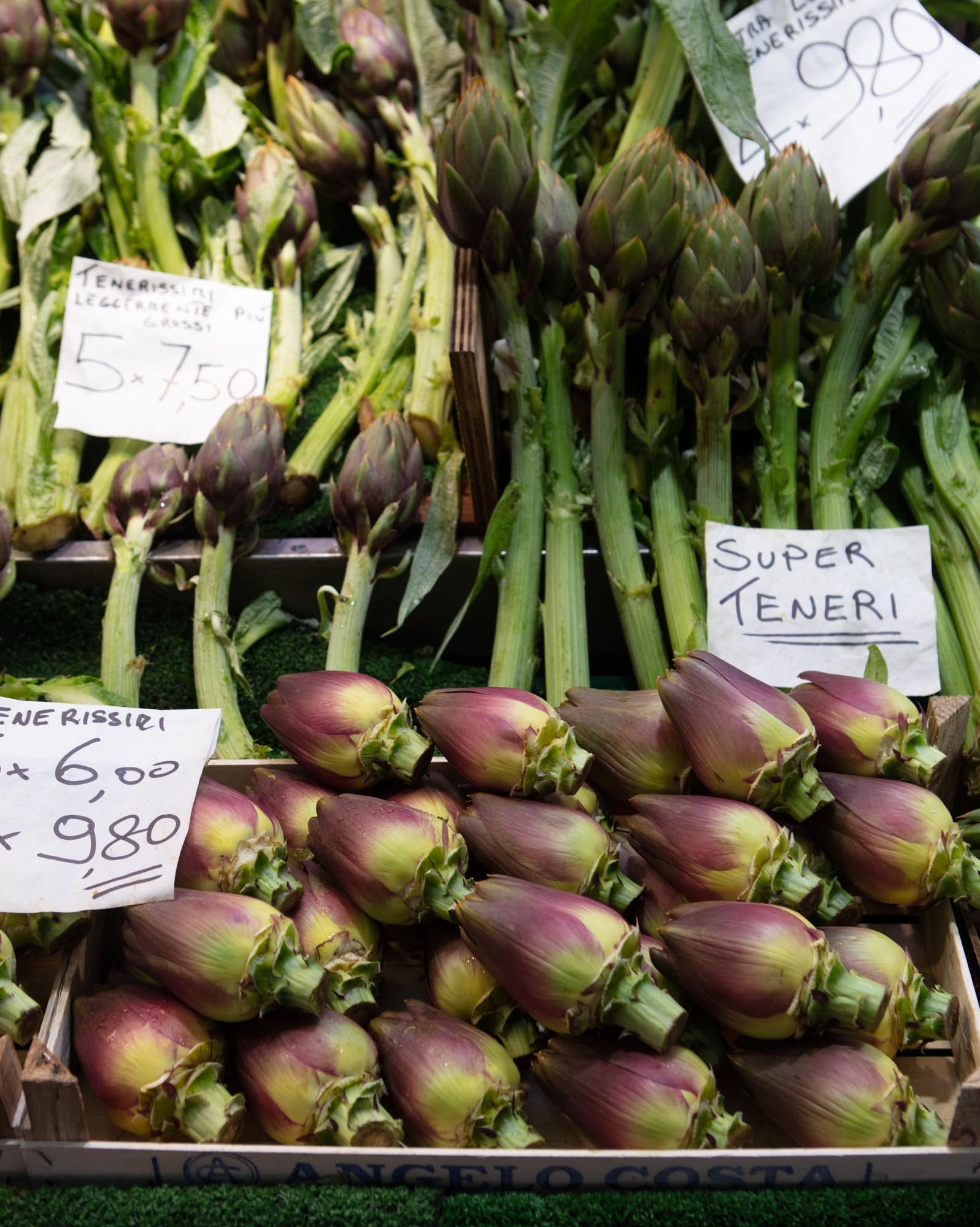
Carciofi, or artichokes, have intimidated me since I moved to Italy. I grew up eating only one kind of artichoke (the globe), prepared only one way: steamed whole and placed in the center of the platter, leaves ripped off, one by one, to be dipped in a mayonnaise or butter sauce.
When I moved to Italy, I was overwhelmed by how often and in how many forms carciofi showed up this time of year; seemingly endless varieties and colors overflowed on market stalls and every restaurant menu boasted numerous carciofi-forward dishes. I found them shaved raw in salads, fried, stuffed, battered, baked, braised, blended… but not a steamed globe in sight.
I would watch in awe as my mother-in-law methodically cleaned the formidable plants, her blackened fingers moving quickly amidst a heap of spiny leaves and stalks, a mysterious bowl of lemon water lurking nearby, slowly filling with cleaned, quartered artichoke hearts.
Over the years, even as I fully embraced Italian cuisine and ingredients, carciofi still felt intimidating, even a little hostile, when I spotted them at the market. Shaped like medieval weaponry and armed with menacing spikes, they seemed to scream “Don’t touch me!” So I didn’t, for a long time.
Eventually, I did. Here’s what took me far too long to learn.
How to buy
Italy is the world’s largest producer of artichokes, so without getting into a regional guide to all the (dozens!) of different varieties available here, I’ll simplify them into two main groups: spiny artichokes or carciofi spinosi and the larger globe artichoke, most popular in and around Rome, the Carciofo Romanesco or Mammola.
Whatever variety you’re buying, look for tightly closed petals and a head that feels firm and heavy, with a sturdy (not limp or floppy) stalk.
In the U.S., we primarily use globe artichokes, which you can use for most Italian recipes as long as you trim it down to the heart like they do here. If you’re lucky, you’ll find baby artichokes in the springtime, which are a true market gem and worth picking up every time you find them. These are probably the closest you’ll get to the Italian style spiny artichokes.
How to prep
First of all, you’re going to want gloves for this job. They not only prevent your fingers from turning black from oxidation, but also protect them from thorns, and from the raw, bitter fluids that can taint other foods.
Next, fill a bowl with cold water and squeeze a half of a lemon into it; keep it nearby to collect the cleaned hearts in, so they don’t oxidize.
Start by pulling away the tough outer leaves until you reach the pale, tender ones and the base of the artichoke begins to show. Trim the stem, leaving about an inch attached, then peel it along with the base so everything is smooth and no longer fibrous. Slice off the top portion of the artichoke, then use a small knife to trim away any remaining dark green parts around the sides.
Cut the artichoke in half lengthwise and scoop out the fuzzy choke in the center with a spoon. Give it a final tidy trim if needed, then drop it straight into lemon water to keep it from browning.
If you’re a visual learner, here is a nice video tutorial by Marcella Hazan’s son (complete with the epic recipe for Marcella’s Roman-style Artichokes).
How to substitute
Jarred and frozen artichoke hearts can be a huge time saver, but only for certain recipes. I wouldn’t recommend substituting fresh carciofi in recipes that rely on the unique texture and structure of the vegetable, such as carciofi alla romana or carciofi alla giudea.
It is perfectly acceptable to use them, however, in pasta sauces, spreads, bruschetta, gratins, salads, etc.
A happy ending
After all the hesitation, I found that I survived my first artichoke encounters largely unscathed, aside from a few pricked fingers. Turns out they weren’t trying to kill me after all.
Once I understood what to look for and how to prep them, carciofi stopped feeling so menacing and became one of my favorite ingredients of the season.
I’ll be sharing a great artichoke recipe next week.
Have artichokes ever intimidated you, or am I alone here? How do you cook them?
Great take!! I can totally relate and feel better knowing that you also had some trepidations about tackling this thistle.
Enjoy all your posts, especially as a transplanted Texan who’s called Italy casa mia for 3 decades.
Looking forward to reading more here on Substack- you’re the reason I decided to jump on the stack to begin with !!